When Your Edmonton Parging Starts Crumbling, Cracking, or Falling Off
Parging does not last forever, and in Edmonton's climate a parge coat eventually shows its age. It starts with a hairline crack or a small chip, then a section sounds hollow when tapped, then patches begin bubbling, crumbling, or coming off in sheets, exposing the bare foundation underneath. Once parging starts failing, it tends to keep failing, and the exposed foundation it was protecting is left open to the moisture and freeze-thaw the parge coat was meant to block. Catching failing parging and repairing it keeps the foundation protected and the problem contained. Depend Exteriors provides parging repair in Edmonton, and knowing the signs is what lets a homeowner act before the damage spreads.
A failing parge coat is both a cosmetic problem and a protection problem, and the sooner it is addressed the smaller the repair. Understanding why parging fails and what the repair involves is what turns a crumbling foundation coat from an eyesore into a simple fix.
Hollow-Sounding Parging Has Failed
A section of parging that sounds hollow when tapped has lost its bond with the foundation and will eventually come off, which is one of the clearest signs a parge coat is failing and exposing the foundation underneath.
.
Failing Parging Exposes the Foundation
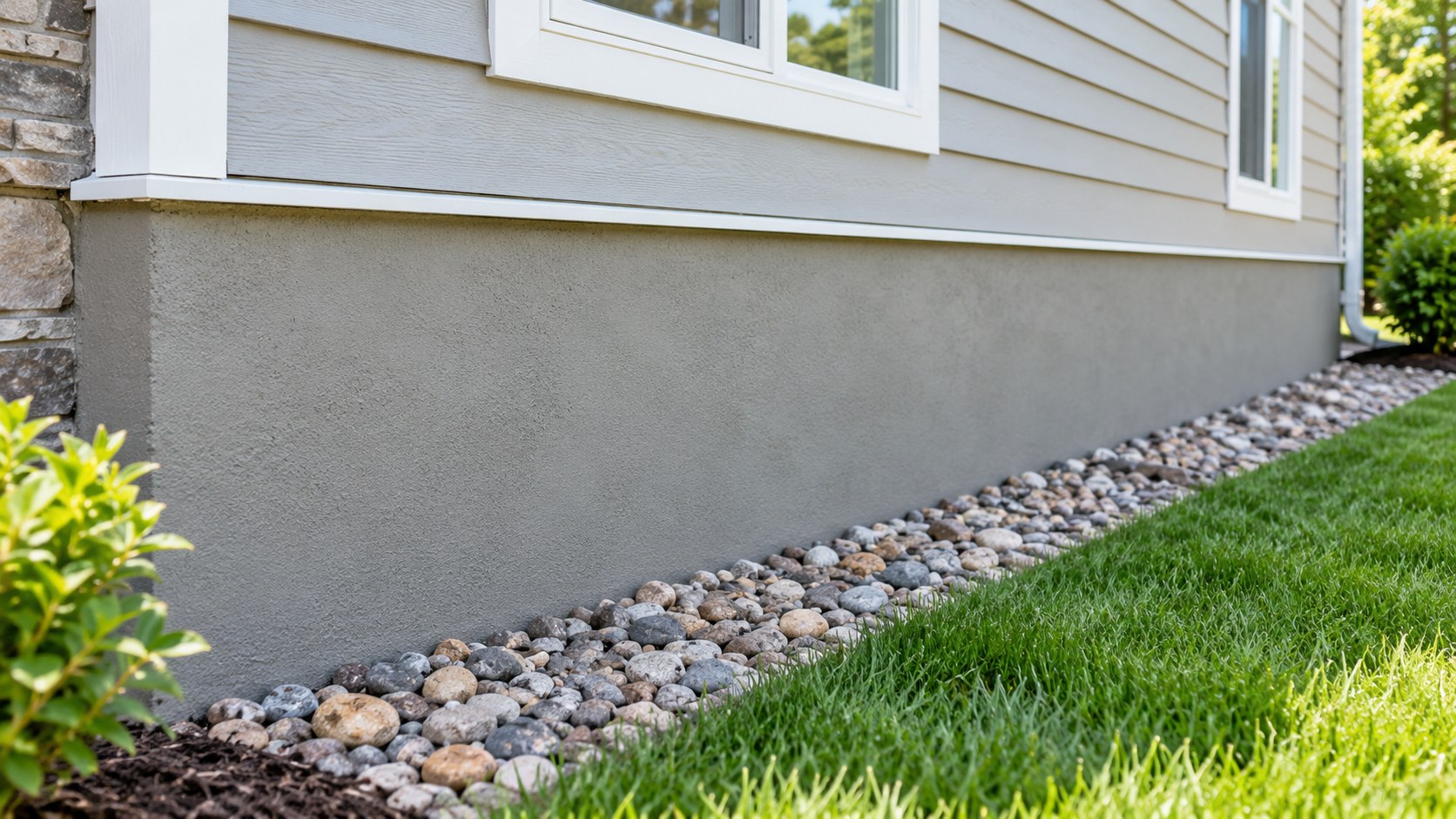
Every crumbling or missing patch of parging exposes bare concrete or block to Edmonton's freeze-thaw and moisture, so a cosmetic-looking parging failure becomes a foundation-protection problem if it is left to spread.
A Matched Repair Blends In
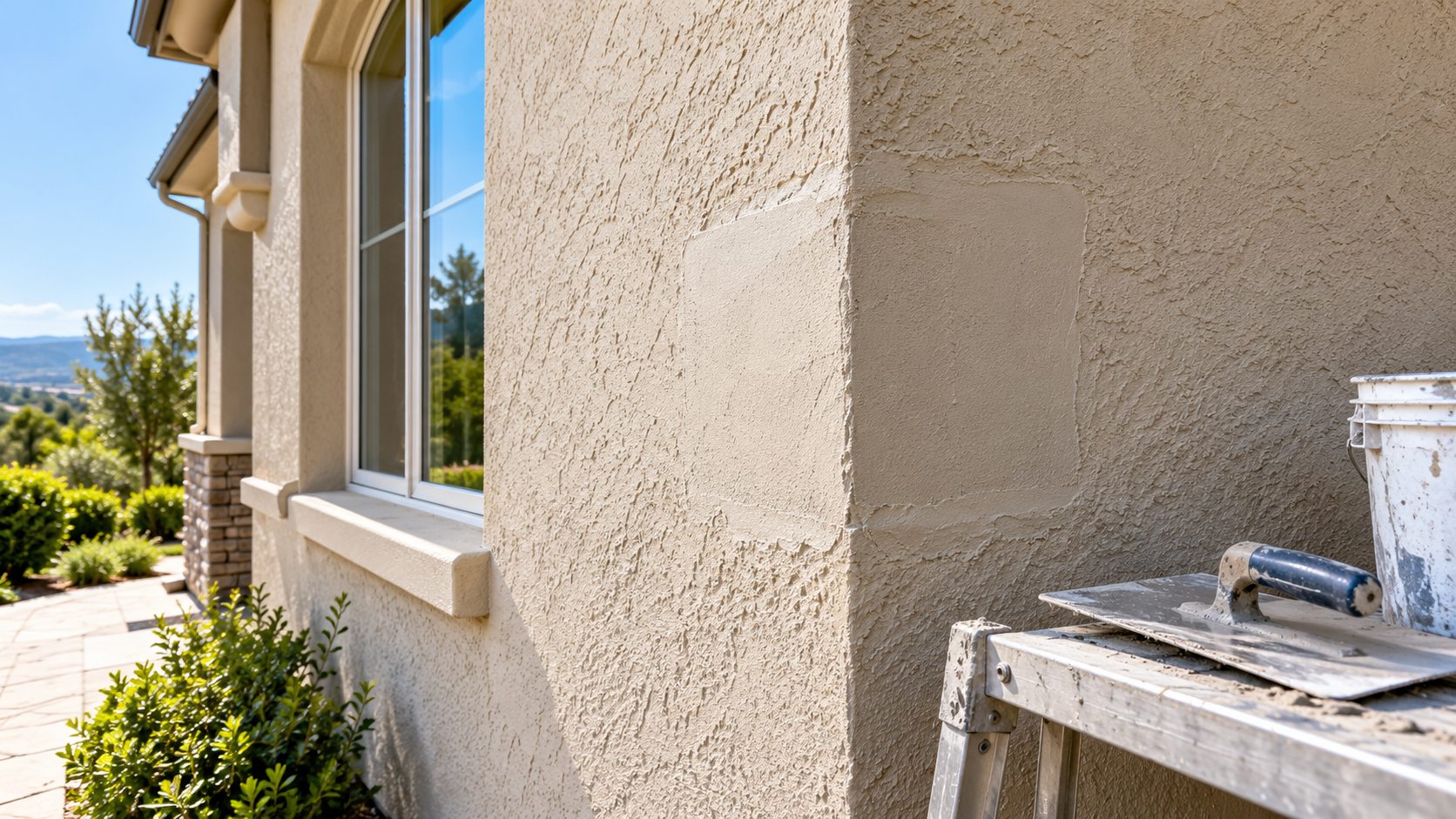
An experienced plasterer matches the texture and finish of the surrounding parging and feathers the new work into the old, so a localized parging repair restores the protection and the look without standing out as an obvious patch.
The Signs Parging Is Failing
Parging gives clear warnings as it fails, and an Edmonton homeowner who knows them can catch the problem early. Hairline cracks are the first sign, and while minor at first, they let water in and grow under freeze-thaw. Wider cracks, chips, and missing chunks follow as the coat deteriorates. A section that sounds hollow when tapped has lost its bond with the foundation and will eventually come off. Bubbling or bulging sections show the coat lifting away from the wall. Discolouration, staining, or a patchy, uneven appearance shows weathering and moisture. And the clearest sign, old parging coming off in sheets or crumbling to the touch, means the coat has failed and the foundation is being exposed. Any of these is a reason to have the parging looked at, because a failing parge coat only gets worse and lets more moisture into the foundation.
The reason these signs matter is what lies underneath. Every failing patch of parging exposes a bit of the foundation to Edmonton's freeze-thaw and moisture, and once water reaches the bare concrete or block, it soaks in, freezes, and damages the foundation itself. What starts as cosmetic, a cracked or crumbling parge coat, becomes a foundation-protection problem if it is left to spread. Repairing the parging while the failure is localized keeps the foundation protected and the repair small.
Parging fails in Edmonton for understandable reasons, and knowing the cause helps prevent a repeat. Freeze-thaw cycling is the main one, as water enters a crack or a porous spot, freezes, expands, and breaks the coat apart over the winters. Moisture penetration from poor drainage, downspouts that discharge too close to the wall, or grade that slopes toward the foundation keeps the parge coat wet and speeds its failure. Salt exposure near driveways and walkways attacks the coat. Foundation settling and soil movement crack it. And a parge coat that was poorly applied in the first place, over a dirty surface, without a bonding agent, or in the wrong season, fails early no matter what. A parging repair that lasts addresses not just the failed coat but, where possible, the cause, such as the drainage or downspout issue keeping the wall wet. Depend Exteriors looks at why the parging failed, so the repair holds.
Repair or Full Replacement
Whether a failing parge coat needs a localized repair or a full replacement depends on how much has failed. Localized damage, a few cracks or a failing patch on an otherwise sound coat, is a repair: the damaged area is cleaned out, the crack or patch is prepared and rebonded, and new parging is applied and texture-matched to blend with the surrounding coat. Widespread failure, where much of the parging is cracked, hollow, or coming off, calls for removing the old coat and applying a full new parge coat, since patching a broadly failing coat only chases the failures. Depend Exteriors assesses how much has failed and recommends the repair when it makes sense and a full recoat when the parging is too far gone, so a homeowner gets the right scope rather than the biggest one.
Colour and texture matching make a parging repair blend in. A careful repair matches the texture and finish of the surrounding parging and feathers the new work into the old, so the repair does not stand out as a patch. That blending is part of what a careful, experienced plasterer brings to a parging repair, and it is why a good repair restores both the protection and the appearance of the foundation coat.
A Contractor for a Lasting Parging Repair
A parging repair that lasts takes proper preparation, rebonding, matched materials, and the technique to blend the repair, which is what Depend Exteriors brings. A family-owned company serving Edmonton since 2013 and led by journeyman plasterer Hasan Yilmaz, it repairs failing parging by addressing the cause, preparing the surface, rebonding and applying matched parging, and blending the repair into the existing coat. The work is licensed, bonded, and insured, compliant with the Alberta Building Code, and backed by a 3-year workmanship warranty. A failing parge coat caught early is a small repair; left to spread, it exposes the foundation and grows.
Catching Parging Failure Early
A parging repair is smaller, cheaper, and simpler the earlier it is caught, which is why paying attention to the first signs matters. A single hairline crack or a small chip is a minor repair, sealed and blended before it spreads. The same failure left through a few Edmonton winters, with freeze-thaw widening the cracks and moisture reaching the foundation, becomes a larger repair or a full recoat, and it exposes the foundation to damage in the meantime. A homeowner who addresses failing parging at the first cracks or the first hollow-sounding patch keeps the repair contained and the foundation protected, while one who waits until the coat is crumbling off faces a bigger job. Depend Exteriors encourages Edmonton homeowners to have failing parging looked at when the first signs appear, because early repair is always the smaller job and it protects the foundation before the exposure does damage.
Serving Edmonton Foundations
Depend Exteriors serves foundations across Edmonton and the surrounding communities, on the older foundations where decades of freeze-thaw have worn the parge coat and on newer ones where a drainage or application issue has caused early failure. Wherever the parging is failing, the approach is the same: find why it failed, prepare and rebond the surface, apply matched parging, and blend the repair into the existing coat, with a full recoat where the parging is too far gone to patch. That careful, cause-first approach is what makes a parging repair hold rather than fail again, and it is what Depend Exteriors brings to Edmonton foundations. Serving the area since 2013, the family-owned crew treats a failing parge coat as a foundation-protection issue, not just a cosmetic one, which is what an Edmonton homeowner needs when the parging starts to go.
The difference between a parging repair that lasts and one that fails again is whether it addresses why the parging failed. A repair that patches a crumbling patch but ignores the downspout dumping water on the wall, the poor drainage keeping the foundation wet, or the grade sloping toward the house will fail again, because the cause is still there. A lasting parging repair looks at the moisture and drainage conditions around the failing coat and, where possible, addresses them, so the repaired parging is not left in the same wet conditions that destroyed the original. Depend Exteriors takes that cause-first approach to parging repair, checking the drainage and moisture situation along with the coat, so the repair holds through the Edmonton winters rather than failing the same way the original did. For a homeowner, that means a repair that solves the problem rather than resetting the clock on it.
When an Edmonton parge coat starts to fail, the sooner it is repaired the better, for both the appearance and the foundation underneath. Depend Exteriors restores failing parging across Edmonton and the surrounding communities with a cause-first, texture-matched, and warrantied repair, family-owned and serving the Edmonton area since 2013 with a 3-year workmanship warranty behind every job.
A failing parge coat is the foundation asking for attention, and answering it early keeps a small repair small while protecting the concrete or block beneath from the moisture and freeze-thaw the coat was installed to block. Left alone, crumbling parging only spreads and exposes more of the foundation to the weather it was meant to block, which is why a timely repair is always the wiser and less costly choice for an Edmonton home and its foundation.
When an Edmonton parge coat starts crumbling, cracking, or falling off, repairing it protects the foundation underneath. For a lasting parging repair in Edmonton, contact Depend Exteriors at (780) 710-3972 for a free on-site assessment.
About Stucco
Construction material made of aggregates, a binder, and water
Stucco or render is a construction material made of aggregates, a binder, and water. Stucco is applied wet and hardens to a very dense solid. It is most commonly used as a decorative and protective cladding for exterior walls and canopies. Stucco can be applied over construction materials such as metal, expanded metal lath, concrete, cinder block, or clay brick and adobe for decorative, protective and/or structural purposes.[2]
In English, "stucco" refers to a cladding for the outside of a building and "plaster" to a cladding for interiors. Other European languages, notably Italian, do not have the same distinction: In Italian, stucco means plaster, and serves for both.[3]
Stucco used as an exterior coating on a residential building.Rock dash stucco used as an exterior coating on a house on Canada's west coast. The chips of quartz, stone, and colored glass measure approx. 3–6 mm (1/8–1/4").
The basic composition of stucco is lime, water, and sand.[4]
The difference in nomenclature between stucco, plaster, and mortar is based more on use than composition. Until the latter part of the nineteenth century, it was common that mortar as well as plaster, which was used inside a building, and stucco, which was used outside, would consist of the same primary materials: lime and sand.
Animal or plant fibers were often added for additional strength. Sometimes additives such as acrylics and glass fibers are added to improve the structural properties of the stucco. This is usually done with what is considered a one-coat stucco system, as opposed to the traditional three-coat method.
In the latter nineteenth century, Portland cement was added with increasing frequency to cover surfaces in contact with soil or water. At the same time, traditional lime plasters were often being replaced by gypsum plaster. Lime is almost as good in balancing humidity as clay. It prevents moisture accumulation inside the building as well as in the wall by its excellent permeability, and is more elastic and workable than cement render.
Lime itself is usually white; color comes from the aggregate or any added pigments. Lime stucco has the property of being self healing to a limited degree because of the slight water solubility of lime (which in solution can be deposited in cracks, where it solidifies). Portland cement stucco is very hard and brittle and can easily crack and separate from the surface if the base on which it is applied is not stable. Typically, its color was gray, from the innate color of most Portland cement, but white Portland cement is also available. Today's stucco manufacturers offer a very wide range of colors that can be mixed integrally in the finish coat. Other materials such as stone and glass chips are sometimes "dashed" onto the finish coat before drying, with the finished product commonly known as "rock dash", "pebble dash", or also as roughcast if the stones are incorporated directly into the stucco, used mainly from the early 20th through the early 21st centuries.
As a building material, stucco is a durable, attractive, and weather-resistant wall covering. It was traditionally used as both an interior and exterior finish applied in one or two thin layers directly over a solid masonry, brick, or stone surface. The finish coat usually contained an integral color and was typically textured for appearance.
Then with the introduction and development of heavy timber and light wood-framed construction methods, stucco was adapted for this new use by adding a reinforcement lattice, or lath, attached to and spanning between the structural supports and by increasing the thickness and number of layers of the total system. The lath added support for the wet plaster and tensile strength to the brittle, cured stucco; while the increased thickness and number of layers helped control cracking.
The traditional application of stucco and lath occurs in three coats—the scratch coat, the brown coat and the finish coat. The two base coats of plaster are either hand-applied or machine sprayed. The finish coat can be troweled smooth, hand-textured, floated to a sand finish or sprayed.
Originally, the lath material was strips of wood installed horizontally on the wall, with spaces between, that would support the wet plaster until it cured. This lath and plaster technique became widely used.
In exterior wall applications, the lath is installed over a weather-resistant asphalt-impregnatedfelt or paper sheet that protects the framing from the moisture that can pass through the porous stucco.
Following World War II, the introduction of metal wire mesh, or netting, replaced the use of wood lath. Galvanizing the wire made it corrosion resistant and suitable for exterior wall applications. At the beginning of the 21st century, this "traditional" method of wire mesh lath and three coats of exterior plaster was still widely used.
In some parts of the United States with a warmer climate (like California, Nevada, Arizona, New Mexico and Florida), stucco is the predominant exterior for both residential and commercial construction. Stucco exterior (with wood frame interior) became a popular alternative in the southwestern United States during the 1970s, as the masonry labor costs for adobe rose.[5]
Iranian relief plaque with confronted ibexes; 5th or 6th century AD (the Sasanian period); stucco originally with polychrome painting; Cincinnati Art Museum (Cincinnati, US)
Maya wall panel depicting Ix K'an Bolon; c. 790 AD(Late Classic period); limestone, stucco and paint; from Pomona (Tabasco), Mexico) Dallas Museum of Art (Dallas, Texas, US)
Stucco has also been used as a sculptural and artistic material. Stucco relief was used in the architectural decoration schemes of many ancient cultures. Examples of Egyptian, Minoan, and Etruscan stucco reliefs remain extant. In the art of Mesopotamia and ancient Persian art there was a widespread tradition of figurative and ornamental internal stucco reliefs, which continued into Islamic art, for example in Abbasid Samarra, now using geometrical and plant-based ornament. As the arabesque reached its full maturity, carved stucco remained a very common medium for decoration and calligraphic inscriptions. Indian architecture used stucco as a material for sculpture in an architectural context. It is rare in the countryside.
In Roman art of the late Republic and early Empire, stucco was used extensively for the decoration of vaults. Though marble was the preferred sculptural medium in most regards, stucco was better for use in vaults because it was lighter and better suited to adapt to the curvature of the ceiling. Baroque and Rococo architecture makes heavy use of stucco. Examples can be found in churches and palaces, where stucco is mostly used to provide a smooth, decorative transition from walls to ceiling, decorating and giving measure to ceiling surfaces. Stucco is an integral part of the art of belcomposto, the Baroque concept that integrates the three classic arts, architecture, sculpture, and painting.
The Greco-Buddhist art of modern Afghanistan and northern Pakistan made extensive use in monasteries and temples of stucco for three-dimensional monumental sculpture as well as reliefs. These were usually carved from a rough modelling over a framework and then painted. Similar techniques are used for the life-size statues decorating the gopurams of Hindu temples in modern South Asia.
Since stucco can be used for decoration as well as for figurative representation, it provides an ideal transitive link from architectural details to wall paintings such as the typically Baroque trompe-l'œil ceilings, as in the work of the Wessobrunner School. Here, the real architecture of the church is visually extended into a heavenly architecture with a depiction of Christ, the Virgin Mary or the Last Judgment at the center. Stucco is used to form a semi-plastic extension of the real architecture that merges into the painted architecture.
Because of its "aristocratic" appearance, Baroque-looking stucco decoration was used frequently in upper-class apartments of the 19th and early 20th century.
Beginning in the 1920s, stucco, especially in its Neo-Renaissance and Neo-Baroque materialization, became increasingly unpopular with modern architects in some countries, resulting not only in new buildings without stucco but also in a widespread Movement [de] to remove the stucco from existing tenements.
Stucco was still employed in the 1950s in molded forms for decorating the joints between walls and ceilings inside houses. It was generally painted the same colour as the ceiling and used in designs where a picture rail or rat rail was in use.
Modern stucco is used as an exterior cement plaster wall covering. It is usually a mix of sand, Portland cement, lime and water, but may also consist of a proprietary mix of additives including fibers and synthetic acrylics that add strength and flexibility. Modern synthetic stucco can be applied as one base layer and a finish layer, which is thinner and faster to apply, compared to the traditional application of three-coat stucco. Imitation stone stucco can also be produced using the traditional application, but with marble dust being added to the mixture.
Applying stucco
As with any cement-based material, stucco must be reinforced to resist movement cracking. Plastic or wire meshlath, attached with nails or screws to the structural framing, is embedded into the base coat to provide stiffening for the stucco.
Where stucco is to be applied to a structure of wood-framing or light-gauge steel framing, the framing is protected from moisture damage by applying a cement based primer, or a vapor-permeable, water-resistant weather barrier; typically an asphalt-saturated paper or one of a variety of manufactured plastic-based sheets, known as "building wraps" or "stucco wraps". The properties of the weather barrier must not only protect the framing from rain and moisture, but at the same time allow the free passage of any water vapor generated inside the building to escape through the wall.
A wide variety of stucco accessories, such as weep screeds, control and expansion joints, corner-aids and architectural reveals are sometimes also incorporated into the lath. Wire lath is used to give the plaster something to attach to and to add strength. Types include expanded-metal lath, woven-wire lath, and welded-wire lath.
The tools used to plaster walls
If applied during very dry weather, the layers of stucco are sprayed with water for one or more days to keep a level of moisture within the stucco while it cures, a process known as "moist curing". If the stucco dries too soon, the chemical hardening ("hydration") will be incomplete, resulting in a weaker and brittler stucco.
Ling, Roger, ed. (1999). Stuccowork and Painting In Roman Italy. Aldershot: Ashgate.
Wadsworth, Emily (1924). "Stucco Reliefs of the First and Second Centuries still Extant in Rome". Memoirs of the American Academy in Rome. 4 (4): 9–102. doi:10.2307/4238518. JSTOR4238518.
Beard, Geoffrey (1983). "Stucco and Decorative Plasterwork in Europe". cite journal: Cite journal requires |journal= (help)
Mainly freeze-thaw, as water enters a crack, freezes, and breaks the coat apart, along with moisture from poor drainage or downspouts, salt exposure near walkways, foundation settling, and poor original application. Depend Exteriors addresses the cause, such as drainage, along with the parging repair, so the fix holds in Edmonton.
Can parging be repaired, or does it need full replacement?
It depends on how much has failed. Localized damage on an otherwise sound coat is a repair, cleaned, rebonded, and texture-matched to blend in, while widespread failure calls for removing the old coat and applying a new one. Depend Exteriors assesses the extent and recommends the right scope for a parging repair in Edmonton.